Who it is for
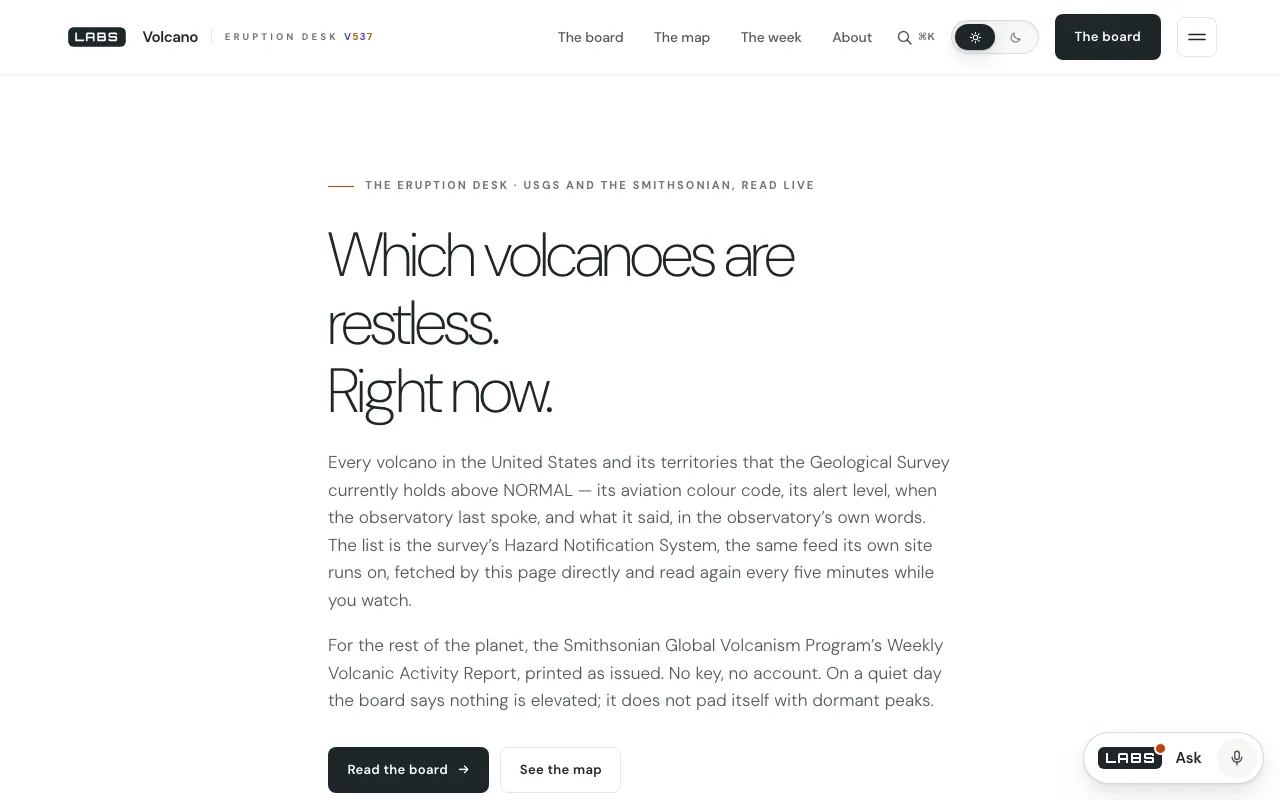
Travellers, pilots’ families, students and news readers who want to know at a glance which US volcanoes are restless and what the observatories actually said. It calls itself “a desk, not an observatory”, and it is not a safety service.
How it works
The USGS Hazard Notification System’s public API allows browsers, so the page reads it directly: the elevated list, each notice’s text (split per volcano so the synopsis can be printed), and the list of monitored volcanoes, which gives a quiet day its denominator. It refreshes every five minutes, and only while the tab is visible.
The Smithsonian’s weekly report sends no CORS header, so it arrives through gvp-proxy.php. That relay has one fixed route and no URL parameter, keeps a 30-minute cache, checks that what came back is RSS and passes it on unchanged.
Positions come from the notice when it carries them, otherwise from a list of 161 US volcanoes taken from the survey on 6 September 2026; with neither, no dot is drawn. Rings pulse only while a notice is under six hours old.
What we tested
All times are UTC on 27 September 2026, measured against a copy of labs.llc build 537 served from our own machine, or against the public source the page itself calls.
- The USGS elevated list, as the page reads itFour volcanoes: Great Sitkin ORANGE/WATCH and Shishaldin YELLOW/ADVISORY (Alaska Volcano Observatory), Kilauea ORANGE/WATCH (Hawaiian Volcano Observatory), Ahyi Seamount YELLOW/ADVISORY (listed under NMI).
- The monitored denominator69 volcanoes.
- The weekly report through the relay200, 26,247 bytes, 20 items, published 17 September 2026.
- The same report direct from the SmithsonianIdentical: 26,247 bytes, same publication date.
- The relay asked for an unknown feed400: “feed must be one of: weekly”.
The byte-for-byte match between the relayed and direct copies is the evidence that the relay passes the report through untouched. Among that week’s items was Krakatau, headed “New Eruptive Activity”.
How it compares
We checked each alternative’s own pages on 27 September 2026 and describe only what we saw there. Each gets the pick below when it does the job better.
USGS Volcano Hazards Program
checked 27 Sep 2026The US government programme whose five observatories — AVO, CalVO, CVO, HVO and YVO — monitor volcanoes and issue the formal notices. Its site offers updates, an interactive map of volcanoes, earthquakes, monitoring instruments and past lava flows, and long-term hazard assessments.
Better at
- It is the source of every notice and colour code the desk shows.
- Its map adds earthquakes, instruments and past lava flows.
- Hazard assessments for places at risk.
Where Volcano goes further
- Only what is elevated right now, on one page, each synopsis inline, with the monitored count beside it.
- The weekly world report on the same page.
Global Volcanism Program (Smithsonian)
checked 27 Sep 2026The Smithsonian programme that documents Earth’s volcanoes and their eruption histories, keeps the Volcanoes of the World database, publishes a monthly Bulletin and co-publishes the weekly report with the USGS. Its own site refused our fetch, so we checked it through its Wikipedia article (linked) and a search that returned its pages.
Better at
- Worldwide coverage, a searchable database and eruption histories.
- It writes the weekly report the desk reprints.
Where Volcano goes further
- Joins that report to the live US list and a map, with the US side refreshed every five minutes.
VolcanoDiscovery
checked 27 Sep 2026A worldwide volcano and earthquake site: activity news, maps of current eruptions, live webcams, an earthquake database searchable by country or region, archives from 2010, tours and mobile apps.
Better at
- Worldwide live coverage, webcams and earthquakes.
- Mobile apps.
Where Volcano goes further
- Official notices only, in the observatories’ words with their send times, and the Smithsonian report passed through verbatim.
- Says when a notice is fresh, and will not draw a position it does not have.
Where it falls short
- Live mapping is US-only. The world arrives as the weekly report’s text, which on our test day was the 10–16 September report published on the 17th — ten days old, because nothing newer was in the feed yet.
- No webcams, earthquake plots, ash advisories or hazard maps.
- Positions for volcanoes without coordinates in the notice come from a list saved on 6 September 2026, not read live.
- The drawn coastline (Natural Earth 1:110m) is too coarse to show where on an island a volcano sits.
Which one to pick
| If you need… | Pick |
|---|---|
| Which US volcanoes are elevated now, in the observatories’ words | Volcano deskours |
| A weekly world round-up next to the US list | Volcano deskours |
| Earthquakes, instruments or hazard assessments | USGS Volcano Hazards Program |
| An eruption history, or any volcano worldwide | Global Volcanism Program |
| Webcams or live world coverage | VolcanoDiscovery |
The fit
Best for
- A daily glance at US volcanic alert levels
- Reading the official synopsis without hunting through each observatory
- Students who need the source’s own words to quote
Not for
- Safety decisions — follow the observatories and local authorities
- Watching an eruption on camera
- Live coverage outside the United States
Pick Volcano if you want today’s official US volcano notices on one page, in the observatories’ own words.
Sources for this review
- volcano/assets/js/app.js in build 537 — header lines 3–22, endpoints at 27–29, timers at 31, notice parsing at 155–163, freshness at 198 and 390–423, visibility at 490–494; volcano/gvp-proxy.php header lines 1–35 and routes at 44–50
- USGS Volcano Hazards Program, the Global Volcanism Program’s Wikipedia article and VolcanoDiscovery, checked on 27 September 2026 at about 20:04 UTC