Who it is for
It suits people who want to see what the open record says about something, source by source, instead of one ranked page from one engine: researchers, journalists, developers and students. It is not a replacement for a web engine, and it does not pretend to be.
How it works
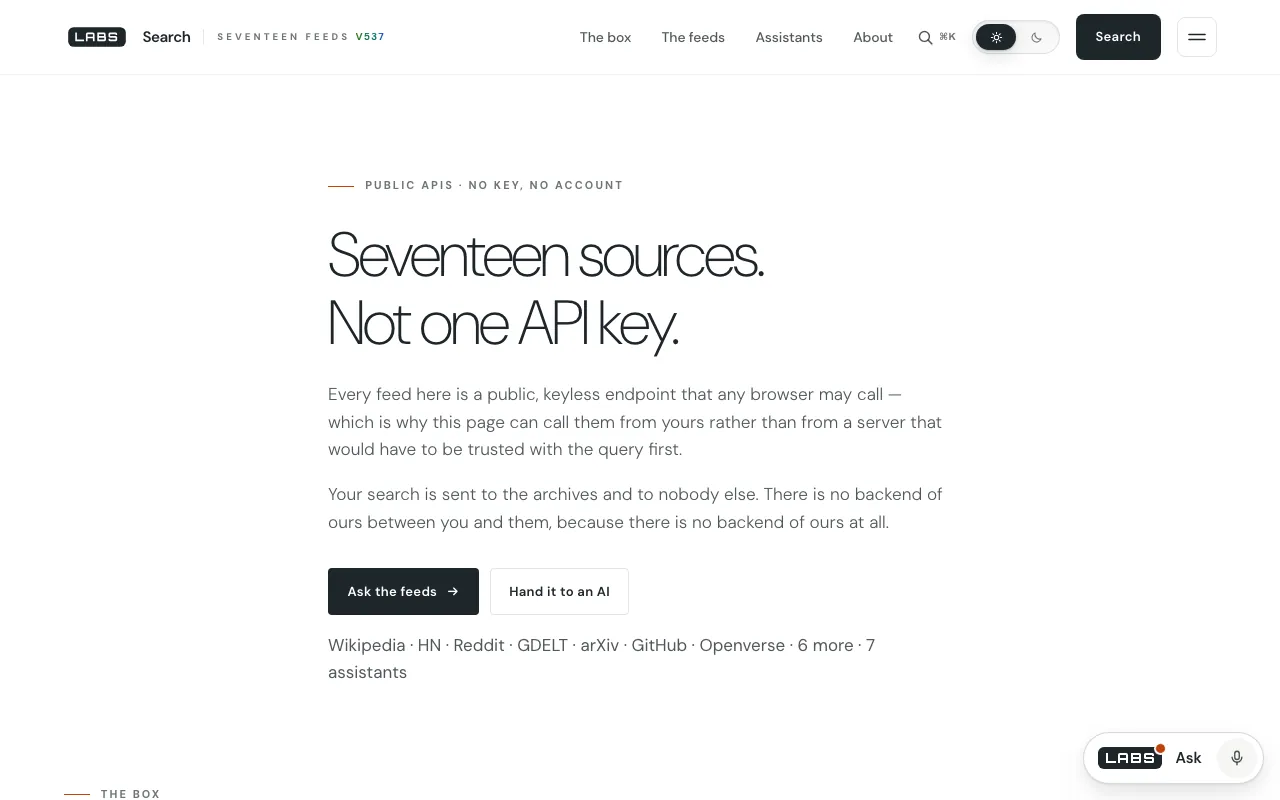
The work happens in your browser. One table in the page’s script defines seventeen fetchers that all return the same shape, and each call is timed. Ten lenses — Web, News, Academic, Code and so on — select subsets of the feeds; the “All” lens is derived from the table itself, a change made after an earlier build listed only nine of the seventeen.
Reddit and arXiv send no CORS header, so a browser cannot read them directly. For those two the page uses its own relay, proxy.php, which fetches from exactly five named hosts over HTTPS and re-checks every redirect hop against that list. Only if the relay is missing does it try the public api.allorigins.win relay.
Before the feeds return it computes a few quick answers from named open data: a coin price from CoinGecko, a currency conversion from Frankfurter, the weather for a place from Open-Meteo. Wikipedia’s spelling suggestion is offered as a button and never applied for you. At the foot, the same query can be handed to seven AI assistants and five ordinary engines.
What we tested
All times are UTC on 27 September 2026, measured against a copy of labs.llc build 537 served from our own machine, or against the public source the page itself calls.
- The page, locally200, 55,010 bytes.
- The relay’s arXiv route, query “koblenz”200, 10,039 bytes of Atom XML in 0.19 s.
- The relay asked for example.comRefused: 403, “host not allowed”.
- The relay’s Reddit route502, “upstream gave no answer” — Reddit did not answer our test machine.
- Three direct feeds for “koblenz”Hacker News 0.23 s, OpenAlex 0.40 s, Open Library 4.89 s.
- Spelling suggestion for “koblence”Wikipedia offered “koblenz”.
The Open Library time is why the desk streams its results: the slowest source decides when the “N/17 feeds answered” line completes, but the quick ones are on screen long before it.
How it compares
We checked each alternative’s own pages on 27 September 2026 and describe only what we saw there. Each gets the pick below when it does the job better.
SearXNG
checked 27 Sep 2026A free, open-source metasearch engine. Its documentation says it aggregates results from up to 261 search services, does not track or profile users, supports Tor and can be run by anyone; about 70 public instances are listed.
Better at
- Up to 261 services, general web engines included, so an ordinary web query returns ordinary web pages.
- You can host it yourself and decide whom to trust.
- Documented Tor support, with JavaScript and cookies optional.
Where Search goes further
- Each source’s answer time and item count on its own line, and a one-feed retry when a source fails.
- Nothing to install or host: the federation runs in the visitor’s browser.
- Quick answers worked out from named open data, with the source on the card.
DuckDuckGo
checked 27 Sep 2026A private general web engine. Its help page says traditional links come largely from Bing plus its own crawler, with Instant Answers from partners and Wikipedia, and that partner requests are proxied so they stay anonymous.
Better at
- A full web index: it finds ordinary web pages — shops, local businesses — that the labs desk cannot.
- One ranked list instead of results grouped by source.
- Instant Answers from licensed partners, such as sports and restaurants.
Where Search goes further
- Names every source it asked and how long each took.
- Separate lenses for arXiv and OpenAlex papers, GitHub, Open Library and Internet Archive holdings, Openverse and Commons images, museum art, and Lemmy and Mastodon posts.
- Passes the same query to seven assistants and five engines — DuckDuckGo among them.
Where it falls short
- It has no web index of its own. The “Web” lens is Wikipedia, Stack Exchange and Hacker News, so a query for a shop or a local business will not find what a general engine would.
- At most eight rows per feed, and no single ranking across sources; results arrive grouped, in the order the feeds answer.
- Two feeds lean on a relay. In our test the Reddit route failed with a 502, and the last-resort fallback is a third-party public relay that your query would then pass through.
- Google News is absent: it sends no CORS header and the public relay did not serve it.
Which one to pick
| If you need… | Pick |
|---|---|
| What papers, code, books and forums say about a topic, side by side | Searchours |
| See which source answered, and how quickly | Searchours |
| Find a shop, a business or an ordinary web page | DuckDuckGo |
| A metasearch engine you run yourself, or use over Tor | SearXNG |
The fit
Best for
- Research across encyclopaedia, papers, code, books and pictures in one sweep
- People who want every result labelled with where it came from
- Handing a query to an assistant or another engine without retyping it
Not for
- Everyday searching for products, shops and ordinary web pages
- One ranked list of the single best result
- Anyone who needs every source to answer every time
Pick Search if you want the public record’s answer, source by source, and can do without a web index.
Sources for this review
- search/assets/js/app.js in build 537 — feed() at lines 116–140, FEEDS at 145–380, suggestion() at 393–411, LENSES at 414–426, quick answers at 440–495, per-feed lines and retry at 711–745, hand-off at 796–812; search/proxy.php lines 8 and 16–32
- SearXNG documentation and DuckDuckGo’s “Sources of results” page, fetched on 27 September 2026 at about 20:02 UTC