Who it is for
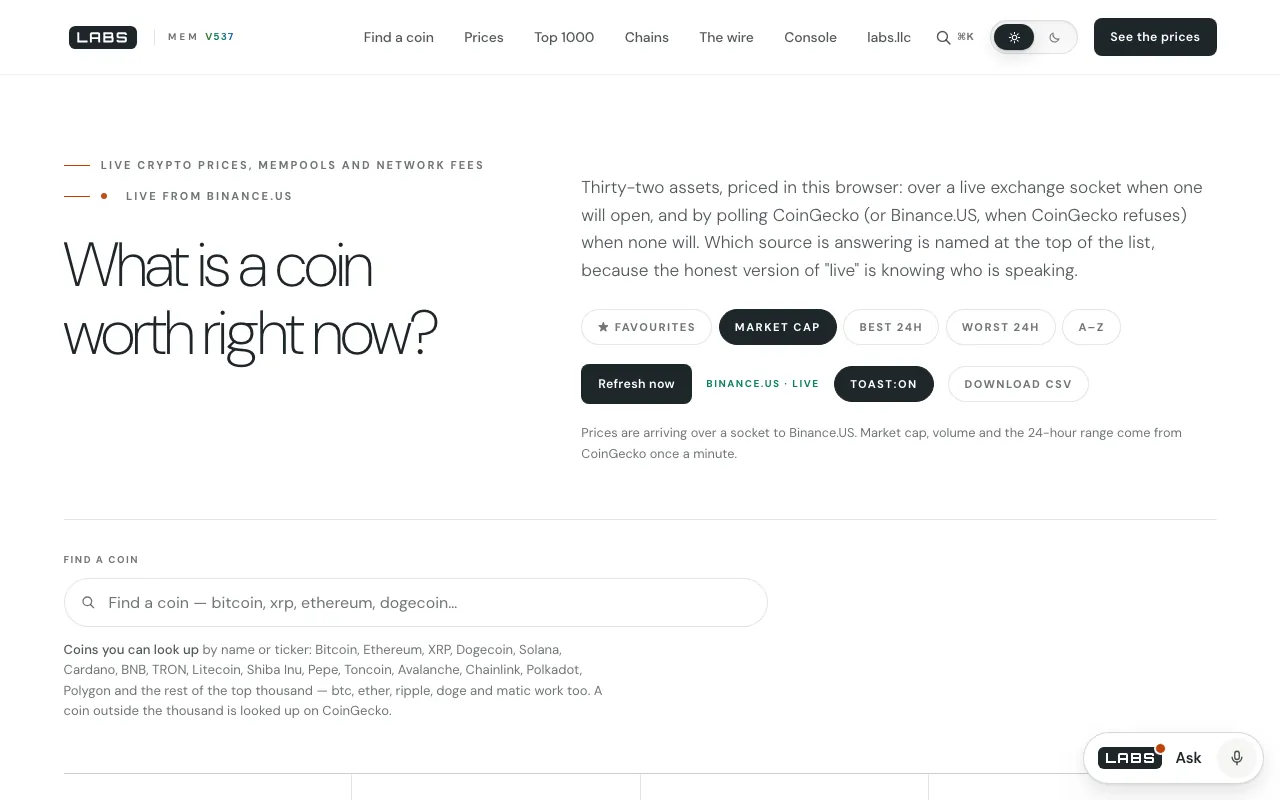
It is for people who want to look up a coin quickly and see where each number came from — casual holders, the curious, anyone tired of dashboards whose figures move without a source. Two skins share one address: a paper reading and a dark live console.
How it works
Live prices come from a chain of WebSocket venues tried in order — Binance, then Binance.US, then Coinbase — because Binance answers a US address with HTTP 451. Each venue gets nine seconds to send something useful before the chain moves on; if every venue refuses, polling takes over and the chain tries again in two minutes. The page says which venue it is on.
A coin card is one CoinGecko /coins/markets call with a seven-day sparkline, with CoinPaprika as the named fallback. If the browser is blocked, requests go through the site’s own relay — which is probed before it is trusted: a proxy that answers with PHP source or an HTML page is skipped.
Search runs over the 32 live assets, a nickname table and a bundled list of 1,000 coins before it asks CoinGecko. That list dates from May 2026, so it supplies names and tickers only; its prices are never shown. On-chain panels read Bitcoin from mempool.space, Ethereum from Blockchair and public RPC, Dogecoin and Litecoin from Blockchair, Solana from a public RPC and TRON from TronGrid. Every other chain shows a dash. An earlier build had animated those panels with Math.random(); this one refuses to.
What we tested
All times are UTC on 27 September 2026, measured against a copy of labs.llc build 537 served from our own machine, or against the public source the page itself calls.
- The two documents behind /mem/Paper 200, 95,116 bytes; dark console 200, 370,998 bytes.
- The relay health probe400 with a JSON error — the answer the page takes as proof that the relay is running.
- A card’s data through the relay (Bitcoin, XRP)200, 7,719 bytes in 0.013 s: Bitcoin $84,731 (+0.87%), XRP $1.53 (+0.60%), 168 hourly sparkline points each. The first try, six seconds earlier, came back empty.
- Bitcoin fees from mempool.space1 sat/vB on every tier.
- Counted in the source32 assets in the live deck; 1,000 names in the bundled list.
Prices are recorded as the source reported them at that minute, to show the desk working. They are not advice.
How it compares
We checked each alternative’s own pages on 27 September 2026 and describe only what we saw there. Each gets the pick below when it does the job better.
CoinGecko
checked 27 Sep 2026A crypto data aggregator. On the day we checked it was tracking 21,641 cryptocurrencies across 1,501 exchanges, with a ranked table, one-hour, 24-hour and seven-day changes, market dominance, categories and portfolio tracking.
Better at
- Enormous breadth: 21,641 coins, against 32 live and 1,000 searchable.
- Portfolio tracking and categories.
- It is the primary source — the labs card is itself one CoinGecko call.
Where Crypto goes further
- For its 32 assets, prices stream from a named exchange, with an open fallback chain.
- On-chain readings beside the price: Bitcoin’s mempool and fees, Ethereum fees, Dogecoin and Litecoin pending counts, Solana and TRON figures.
- When CoinGecko fails it asks CoinPaprika and says so, and shows nothing rather than an old figure.
CoinMarketCap
checked 27 Sep 2026A price and market-cap tracker with a ranked table (1h, 24h and 7d change, market cap, volume, circulating supply, seven-day chart), its own Fear & Greed index, a watchlist and a portfolio tracker.
Better at
- A portfolio tracker, which the labs desk does not have, beside its watchlist.
- Its own sentiment index beside a much larger table.
Where Crypto goes further
- Names the source of every live number and falls back in the open.
- Keeps one exchange’s volume apart from the market-wide figure on its tiles.
mempool.space
checked 27 Sep 2026An open-source Bitcoin explorer and mempool visualiser: fee tiers in sat/vB, projected blocks, recent replacements, a mining dashboard and a Lightning explorer.
Better at
- Far deeper Bitcoin detail, and it can be self-hosted.
- It is the desk’s own source for Bitcoin fees.
Where Crypto goes further
- Sets Bitcoin’s mempool beside five other chains and 32 prices in one console.
Where it falls short
- Coverage is narrow: 32 assets live, 1,000 searchable offline, and everything else depends on CoinGecko’s keyless search answering.
- No portfolio and no price alerts. Its only list is a set of starred favourites, kept in this browser’s storage and shared between the two skins — nothing follows you to another device.
- Mempool figures exist for six chains only; the rest show a dash by design.
- The dark console is heavy — 370,998 bytes of HTML before its scripts.
- In our test the first relay request for a card came back empty; only the retry carried data.
Which one to pick
| If you need… | Pick |
|---|---|
| A quick price with its source named | Crypto deskours |
| Fees and mempools for several chains on one screen | Crypto deskours |
| A coin outside the top thousand, or a category view | CoinGecko |
| A portfolio tracker | CoinMarketCap or CoinGecko |
| Everything about Bitcoin’s mempool and mining | mempool.space |
The fit
Best for
- Checking what a major coin is worth, and who says so
- Watching fees and on-chain activity across Bitcoin, Ethereum and four other chains
- Sharing a coin card by link (/mem/?coin=…)
Not for
- Tracking a portfolio or setting alerts
- Coins outside the top thousand, which depend on CoinGecko’s search answering
- Slow phones on a data budget, in the dark console
Pick Crypto if you would rather see a dash than a number nobody can source.
Sources for this review
- mem/mem-core.js in build 537 — header lines 5–17, relay probe at 33–68, DECK at 254, VENUES at 317–360, volume split at 353–357, watchdog at 386–400; mem/mem-find.js header lines 21–38; mem/mem-chain.js lines 4–28; favourites in mem/_ed-paper.html lines 960–985 and mem/crypto-dashboard.js lines 1733–1777 (localStorage key mem_favorites)
- CoinGecko, CoinMarketCap and mempool.space, fetched on 27 September 2026 at about 20:02 UTC